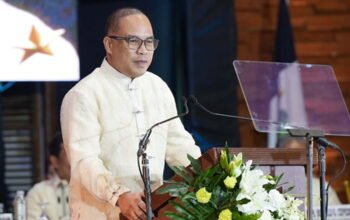
THE number of political dynasties in the country is growing by each year after the EDSA in 1986, according to anti-dynasty advocate Atty. Michaela “Mikee” Defensor in recent forum held at the Holy Spirit School in this city.
She said that about 19% of the political elective posts being held by political families during the pre-EDSA. But after the People Power, it swelled to at least one percent every year.
She said that it’s about 80% almost “absolute” control of the “high-value” by political dynasty in government positions. About 87% of the provincial governors while some 76% of the municipal/city mayors in the country are coming from political dynasty.
Defensor said this means that an average of 170 news dynastic officials are added every after the election. This increased to 29% average positions in 2017.
“A Conversation on Political Dynasties” forum was launched as tribute to EDSA after 40 years courtesy of the KAAJO Bohol, Diocese of Tagbilaran, End Vote-Buying Movement, Lihok Bol-anon and Bohol society.
The 1987 constitution provides, Section 26, Article II “a fundamental precept in our practice of politics The State shall guarantee equal access to opportunities for public service and states a specific measure through which the same may be achieved ([The State shall] prohibit political dynasties as may be defined by law.”
A political dynasty (also referred to as a political family) is defined as a family in which multiple members are involved in politics, particularly electoral politics. Members may be related by blood or marriage; often several generations or multiple siblings may be involved.
In Bohol, for instance, at least four families whose father-mother-son have all became municipal mayor in each respective turf that turned as if it is their fiefdom, aside from their other relatives who are/were also in the elective posts.
Defensor said that the methodologies behind the political dynasty are like, “continuity of reform,” “invested leadership” and “inherited experience.” But these worsen the situation, like poverty, monopoly of power and lack of check and balance precept.
Associate Professor of the Department of Political Science, Ateneo de Manila University, Carmel “Melay” Abao expressed that the intent of political dynasty is to transfer the dynastic politics to “inclusive politics.”
She added that instead of following the footsteps of the political family, the choice of the candidates must be based on democratic processes under the political party, if not the people has the equal opportunity to elect a candidate. The elections must be based on the merits, not on the family name.
Abao also stressed that a law in political dynasty should prevent a political family from ‘dynastic arrangements’ and prevent them from clinging a political power.
Even there’s an Anti-Dynasty Law still it’s not enough. This should be implemented with Political Party Development Law, political finance reform, amendment of the Omnibus Election Code and Comelec’s oversight to achieve a true electoral reform. (RVO)