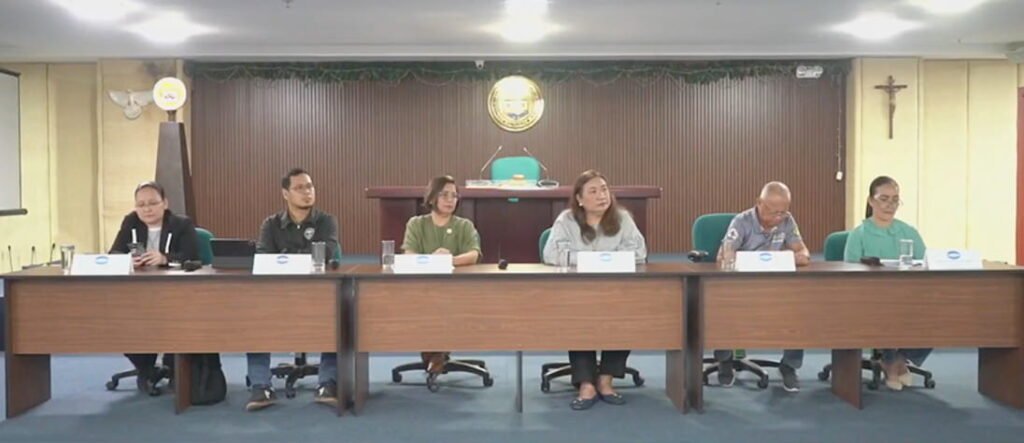
THE weekly “The Capitol Reports” featured Bohol’s intensified dengue response, bringing health officials together to address rising cases and strengthen community action.
The August 28, 2026 episode, held at the Sangguniang Panlalawigan Session Hall, centered on the province’s dengue situation following Governor Aris Aumentado’s declaration of a dengue outbreak through Executive Order No. 40, Series of 2026, signed on August 25.
The discussion featured Provincial Health Office (PHO) Department Head Dr. Fruserma Mary Uy, Provincial Dengue Program Coordinator Leonidas Saniel, RN, and Health Education and Promotion Officer Fritzie Vallentos Olaguir, RN.
Also joining the episode were Niel John Oclarit, RN, Development Management Officer IV of the Department of Health (DOH)—Bohol; Dr. Mutya Kismet Tirol-Macuno, First District Board Member and Vice Chairman of the Committee on Health and Public Sanitation; and Dr. Jeia Pondoc, Tagbilaran City Health Officer.
RISING CONCERN
Dr. Uy described the rising number of dengue cases as alarming, particularly the sudden increase and the province’s case fatality rate of 1.12 percent, exceeding the desired threshold of below one percent.
From January 4 to August 22, Bohol recorded 1,863 dengue cases and 21 fatalities.
Olaguir noted that children aged one to 10 years old account for most of the reported cases, while fatalities have also increased compared with the same period last year.
The areas with the highest recorded cases include Talibon, Tagbilaran City, Ubay, Getafe, Tubigon, Inabanga, Trinidad, Dauis, Mabini, Candijay, and Jagna.
Despite the figures, Dr. Uy emphasized that dengue is preventable and manageable when communities recognize symptoms early and consistently observe protective measures.
COMMUNITY RESPONSE
The outbreak declaration followed the recommendation of the Provincial Local Health Board, supported by the Regional Epidemiological Surveillance Unit of the Central Visayas Center for Health Development and the Provincial Health Office–Provincial Epidemiological Surveillance Unit.
Under EO No. 40, local government units are directed to strengthen the 4S Strategy, reactivate Local Dengue Task Forces, mobilize households, schools, and communities for mosquito breeding-site search-and-destroy activities, and implement the 1-3-7 Intensified Vector Control Strategy for confirmed cases.
Oclarit stressed that dengue prevention starts at home through community-based vector control. He reiterated the 4S Strategy—Search and destroy breeding sites, Self-protection, Seek early consultation, and Support fogging or spraying in identified hotspot areas.
Saniel also urged barangays to strictly enforce their ordinances and sustain information and education campaigns.
He reminded the public that dengue-carrying mosquitoes are most active two hours after sunrise and two hours before sunset.
COLLECTIVE ACTION
Dr. Pondoc stressed that dengue prevention is not solely the responsibility of health workers and local authorities but a shared responsibility among families, schools, barangays, and communities.
Board Member Macuno likewise called on Boholanos to remain vigilant and work together to prevent further increases in dengue cases.
Under the leadership of Gov. Aris Aumentado, the Provincial Government of Bohol (PGBh) continues its commitment to responsive public service, especially in effective health management, to improve the quality of life of Boholanos.
Guided by PGBh’s Strategic Governance Roadmap, the province upholds community participation in protecting both the well-being of its people and the sustainable future of Bohol, the country’s first and only UNESCO Global Geopark. (PIMO/MAPI)