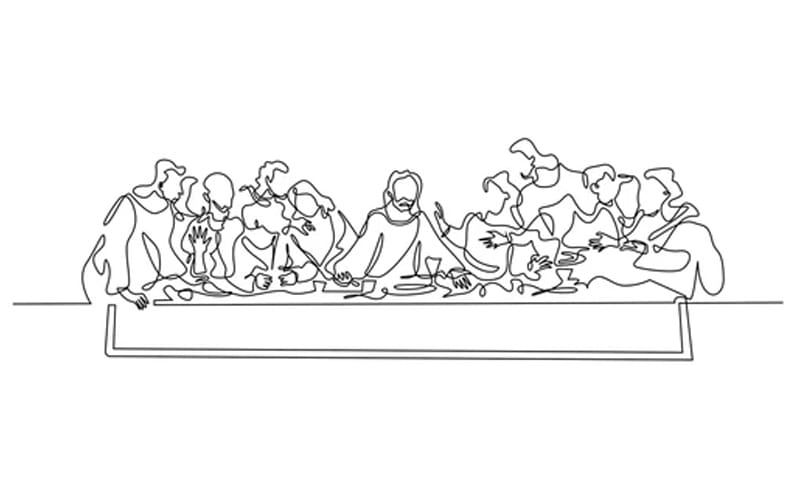
The Mass of the Lord’s Supper, celebrated in the evening of Maundy Thursday, commemorates the Last Supper, the institution of the Eucharist and the priesthood. It also marks the beginning of the Easter Triduum. It’s a joyful Mass, distinct from the somber services on Good Friday, and includes unique elements like the washing of the feet and a procession of the consecrated host.
It is held in the evening to align with the Jewish Passover tradition. In includes some unique rituals like the washing of the feet of twelve persons to symbolize Jesus’ command to serve and to be humble always. There is also an Altar of Repose where the consecrated hosts are carried in procession for adoration, somehow replaying Jesus’ prayer in Gethsemane. Then the altar is stripped bare, and the church becomes quiet, leading into the silence of Good Friday.
And thus begins the Easter Triduum, a three-day liturgical celebration, beginning with the Evening Mass of the Lord’s Supper on Maundy Thursday, continuing through Good Friday (Passion of the Lord), and culminating in the Easter Vigil on Holy Saturday, ending with the Evening Prayer on Easter Sunday that commemorates Jesus’ Passion, Death and Resurrection.
All these celebrations are considered as one continuous liturgy. And while everyone is encouraged to participate as actively as possible in all of them, there is no obligation for us to attend, except the one of the Easter Sunday.
We just have to remember that the Easter Triduum is the most solemn three-day Christian observance that marks the core of our Christian faith and the culmination of the liturgical year. Its significance lies in reliving Christ’s redemptive sacrifice, beginning with Last Supper, moving through his crucifixion, and culminating in the triumph of the Resurrection at the Easter Vigil.
In all of these, what is shown is God’s tremendous love for all of us that is able to conquer whatever evil we may commit. But, of course, with at least a trace of our cooperation. This Easter Triduum is a great occasion for us to savor this love of God for us which is not meant to spoil us but rather to prod us to correspond as best that we can.
The principle to follow here is that God’s love for us should be repaid also by our love for him and for everybody else. We are called to respond to God’s total, gratuitous, and merciful love with a similar total self-giving, even it involves great sacrifice. We should avoid responding to that love with ingratitude or indifference.
This, of course, means that we have to learn to give ourselves entirely to God and to others without counting the cost or expecting any reward, trusting that God will never fail to provide us with what we truly need.
This also means that we should learn to love with a universal scope, extending our love to everyone, including enemies, since God is kind even to the ungrateful and gives special attention to the lost, as dramatized in the parables of the Lost Sheep, the Lost Coin and the Prodigal Son.
This definitely would require us to go through a lifelong process of developing virtues with the view of becoming more and more like Christ and assuming the very spirit of love of God in whose image and likeness we have been created.
Let’s hope that these considerations are not lost as we go through the celebration of the Easter Triduum that starts in the Evening Mass of the Last Supper on Maundy Thursday. (Fr. Roy Cimagala)