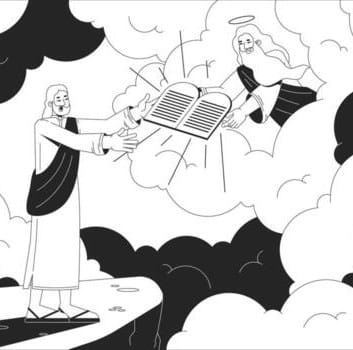
Somehow, when Christ said, “Do not think that I have come to abolish the law or the prophets. I have come not abolish but to fulfil,” (Mt 5,17) we are led to realize that there must be different categories and levels of law and that in the end, the ultimate distinction is between divine law and human law.
Divine law, of course, comes from a higher power, no less than God himself, and covers everything in our life since it focuses on the moral and spiritual dimensions of our life. Human law is made by men through a variety of agencies, and it mainly focuses on rules for social order, rights and governance.
This divine law has been embodied, revealed and commanded of us by Christ, the son of God who became man to redeem us and the very pattern of our humanity. As such, he rightly claims to be the fulfillment of all the laws we have.
We have to disabuse ourselves from the thought that our laws can be based only on our common sense, or on our own estimation of what is good and evil according to the values of practicality, convenience, etc., or on our traditions and culture, etc.
While these things have their legitimate role to play in our legal and judicial systems, we have to understand that they cannot be the primary and ultimate bases. It should be God, his laws and ways that should animate the way we make laws as well as the way we apply and live them. After all, being the Creator of all things, he is the one who establishes what is truly good and evil, what is right and wrong, what is fair and unfair.
In this regard, we have to learn to distinguish and properly blend both the letter and spirit of our human laws. That’s the ideal. In our earthly reality, of course, the letter of the law will always be found wanting in terms of capturing the whole spirit of the law which should channel the spirit of God.
This discrepancy between the letter and the spirit of the law has been referred to a number of times in the gospel. One example is when Christ told the Jews: “You are experts at setting aside the commandment of God in order to keep your tradition.” (Mk 7,9)
We need to understand that our laws, both in the civil and especially in the ecclesiastical sphere, should be animated by the spirit of God who knows all things and keeps everything in its proper order. We should not just make our laws, interpret and apply them to specific cases by basing them only on our own estimation of things, inspired only by some cultural, historical, political, social, economic or some ideological ethos.
We need to realize that it is Christ who ultimately gives the real meaning and purpose of our laws. We have to disabuse ourselves from the thought that our laws can be based only on our common sense, or on our own estimation of what is good and evil according to the values of practicality, convenience, etc., or on our traditions and culture, etc.
For this, we have to learn how to assume the very identity of Christ. This may need a certain discipline, like spending time meditating on the life and teachings of Christ, developing the art of being recollected and contemplative so that we would always be aware that our thoughts, desires, words and deeds should always be with Christ and not just by our own selves. (Fr. Roy Cimagala)