- PDC backs infrastructure, agriculture, tourism, environment, public safety and digital projects for regional funding
THE Provincial Development Council (PDC) Executive Committee has endorsed a wide-ranging package of priority programs and projects for 2028 covering infrastructure, agriculture, tourism, trade, employment, environmental protection, public safety, irrigation and digital connectivity.
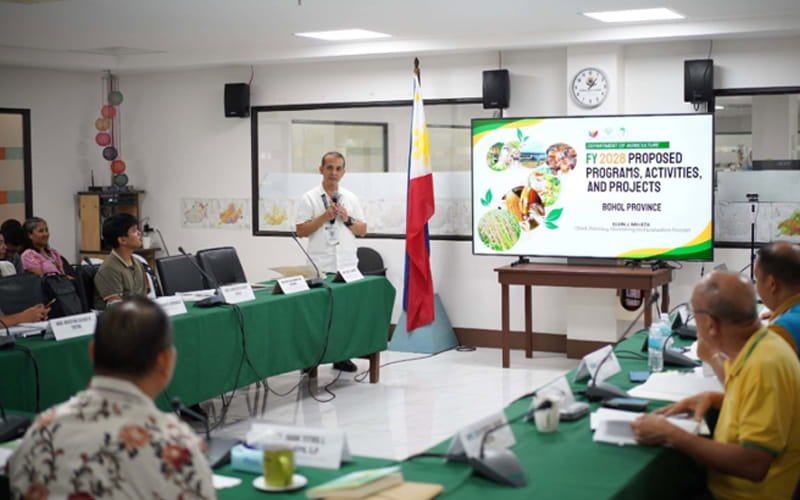
The endorsements were made during a series of sectoral deliberations from October 26 to 29, 2026, as the province consolidated priority proposals of national government agencies and provincial offices for elevation to the Central Visayas Regional Development Council (RDC) and consideration for possible funding.
The PDC Executive Committee, chaired by Gov. Aris Aumentado, reviewed proposals across the Economic Development, Environment Management, Infrastructure and Development Administration sectors as part of Bohol’s Strategic Governance Roadmap.
MAJOR INFRASTRUCTURE PUSH
Among the biggest proposed investments were projects presented by the Department of Public Works and Highways (DPWH) district engineering offices.
The Bohol 1st District Engineering Office presented 102 projects for 2027 with a combined proposed cost of ₱4.04 billion.
For 2028, the Bohol 2nd District Engineering Office presented 205 proposed projects amounting to ₱10.50 billion, covering roads, bridges, flood control, access roads to seaports, airports, tourism destinations and economic zones.
The Bohol 3rd District Engineering Office, meanwhile, presented 246 proposed Tier 1 and Tier 2 projects worth ₱8.88 billion, including asset preservation, road network development, bridge improvements and basic infrastructure.
The Philippine Ports Authority-Bohol also proposed the restoration and expansion of port facilities, construction of wharf operational areas, installation of a 50-cubic-meter-per-day sewage treatment plant, rehabilitation and retrofitting of Tagbilaran Port, cruise ship port expansion and dredging of the Tagbilaran and Catagbacan ports.
The National Irrigation Administration Region VII likewise secured approval for endorsement of proposed 2028 projects amounting to ₱4.55 billion.
Other infrastructure proposals included a ₱30-million two-storey district office of the Land Transportation Office in Tagbilaran City and a ₱40-million lot acquisition for a proposed Land Transportation Franchising and Regulatory Board satellite office.
DIGITAL CONNECTIVITY
The Department of Information and Communications Technology Regional Office VII presented a ₱140.30-million investment package aimed at strengthening digital services across the province.
The proposed package includes ₱83.10 million for GovNet, ₱43.20 million for free public Wi-Fi access in all 48 local government units, ₱9 million for emergency communications and disaster preparedness, and ₱5 million for Digital Transformation Centers in Tagbilaran City, Tubigon and Ubay.
The projects are intended to improve public service delivery, emergency communications and access to digital government services.
AGRICULTURE, FOOD SECURITY
Agriculture also figured prominently in the province’s 2028 development priorities.
The Department of Agriculture presented programs for rice, corn, livestock and poultry, high-value crops and organic agriculture aimed at improving productivity, increasing farmers’ income and reducing poverty.
The DA-Agricultural Training Institute outlined training and extension programs for farmers and fisherfolk, youth internships and support for geographically isolated communities.
The National Food Authority proposed investments in palay procurement and milling, rice distribution and modernization of postharvest facilities.
The Office of the Provincial Agriculturist also presented projects for possible DA funding aimed at raising agricultural production and mitigating the effects of El Niño.
These include irrigation facilities, farm mechanization, improved rice processing, support for ubi and coffee production, agricultural inputs and storage facilities.
Proposed fisheries interventions include deep-sea fish aggregating devices or payao and fish finders, while the Philippine Coconut Authority proposed expanded coconut planting and fertilization programs for 2028.
The Bureau of Fisheries and Aquatic Resources also proposed livelihood support, coastal resource management initiatives, fisheries technology demonstrations and rehabilitation of production facilities.
TOURISM, TRADE AND JOBS
In tourism, the Department of Tourism presented proposals on tourism planning, industry standards, training and destination marketing.
These include tourism circuit development planning involving Bohol and Cebu, along with continued tourism rehabilitation and recovery programs.
The Department of Trade and Industry proposed programs to support exports, attract investments, develop industries and assist micro, small and medium enterprises through shared service facilities, Negosyo Centers, the One Town, One Product program and business mentoring.
The Department of Labor and Employment also outlined programs to improve worker employability, strengthen MSME competitiveness, protect workers’ rights, maintain industrial peace and provide social protection for vulnerable workers.
The Department of Agrarian Reform, meanwhile, proposed programs on land tenure security, individual land titling, agrarian justice and assistance to agrarian reform beneficiaries, while the Cooperative Development Authority presented cooperative development and regulatory programs.
ENVIRONMENT, CLIMATE RESILIENCE
Environmental protection and climate resilience were also among the major funding priorities.
The Department of Environment and Natural Resources-Provincial Environment and Natural Resources Office proposed programs covering forests and protected areas, wildlife conservation, coastal and marine protection, water resources and land management.
The Environmental Management Bureau Region VII presented solid waste management initiatives and a proposed satellite laboratory, while the Mines and Geosciences Bureau also presented proposed programs and projects for Bohol.
Climate adaptation measures were likewise presented for Balicasag Island and the Loboc River Tourism System to reduce climate risks, protect ecosystems and sustain tourism activities.
The Department of Science and Technology-Philippine Institute of Volcanology and Seismology briefed the council on projects that include the construction of unmanned seismic stations, although these were presented for information and were not part of the proposals endorsed for regional funding.
PUBLIC SAFETY, PEACE AND ORDER
The Development Administration Sector also endorsed priority programs covering police, fire, jail, maritime safety, peace-building and disaster preparedness.
The Bohol Police Provincial Office proposed police facilities, operational equipment, communications systems and crime prevention initiatives to improve law enforcement and public safety.
The National Police Commission also presented programs on police supervision, discipline, personnel welfare and administrative support.
For fire protection, the Bureau of Fire Protection proposed the construction of a fire station, acquisition of modern fire trucks and establishment of a specialized training facility.
The deliberations also highlighted the need for aerial ladder fire trucks for firefighting and rescue operations in high-rise buildings.
The Philippine Coast Guard presented initiatives on maritime security, search and rescue, and marine environmental protection, while the Bohol Maritime Police Station proposed maritime patrol and rescue requirements to improve operational readiness.
The Bureau of Jail Management and Penology also presented proposed improvements to the Bohol District Jail male dormitory, while building and fence improvements were proposed for the female dormitory to strengthen security and provide safer conditions for persons deprived of liberty.
The Department of the Interior and Local Government-Bohol presented infrastructure projects for beneficiary barangays in 19 municipalities to address local needs and improve access to community facilities and services.
The 47th Infantry Battalion, meanwhile, presented peace advocacy, medical missions, youth leadership and disaster response initiatives aimed at strengthening community participation and preparedness.
ONE DEVELOPMENT AGENDA
During the Economic Development Sector deliberations alone, the committee approved the proposed programs, activities and projects of nine national government agencies, with additional recommendations raised during the discussions to be incorporated where applicable.
The environment and agriculture proposals were likewise endorsed for elevation to the RDC, while the infrastructure and Development Administration Sector proposals will also undergo further regional review and possible funding consideration.
Taken together, the proposals form a broad 2028 development agenda that combines economic growth with food security, environmental protection, public safety, infrastructure expansion, digital transformation and climate resilience.
Under the leadership of Aumentado, the province said the initiatives support its goal of pursuing inclusive, resilient and sustainable development across the Bohol Island UNESCO Global Geopark.