PASIG CITY, Philippines – Valencia, Bohol Mayor Dionisio Neil A. Balite has distinguished himself as the only mayor to participate in the Course on Artificial Intelligence (AI) for Local Government Units (LGUs) conducted by the Development Academy of the Philippines (DAP) across its first three batches, highlighting his commitment to harnessing emerging technologies for more responsive, efficient, and compassionate local governance.
Balite successfully completed the 32-hour training program under Batch 3, held on October 6–9, 2026, at the O.D. Corpuz Hall II, DAP Building, Pasig City.
Organized by DAP’s Center for Governance, the course aimed to strengthen the capacity of local government officials and personnel to understand and responsibly apply artificial intelligence in public administration, development planning, decision-making, and frontline service delivery.
*Lone mayor across three batches*
According to information confirmed by DAP following Balite’s personal inquiry, the Valencia local chief executive was the only mayor to have attended the specialized AI course since its first batch.
This distinction was among the reasons Balite was given the opportunity to deliver his impressions during the course’s closing ceremony on October 9, where he shared his insights on the transformative potential of artificial intelligence in local governance and challenged fellow participants to bring their learning to their respective local government units.
“As we conclude this Course on Artificial Intelligence for LGUs here at the Development Academy of the Philippines, I leave with renewed hope for what we can accomplish in Valencia, my hometown,” Balite said.
Reflecting on the four-day training, he emphasized that artificial intelligence offers local governments valuable opportunities to improve planning, accelerate responses to community needs, and make public services more accessible, particularly to vulnerable and underserved sectors.
“From October 6 until today, I have learned that AI can help us plan better, respond faster, and reach people who need government most. I look forward to turning these lessons into practical improvements in our public services with human judgment, privacy, and accountability guiding us,” he declared.
*Challenge to fellow participants*
As the lone mayor-participant, Balite used the occasion to encourage his fellow trainees to become advocates of responsible AI adoption in their respective municipalities and cities.
He stressed that local government personnel who acquire new knowledge and technological skills can play an important role in influencing policy directions and encouraging local chief executives to embrace innovation.
“As the lone mayor attending this course, I encourage you: bring this learning home and inspire your respective mayors. Show them how AI can help address real community needs. Your initiative can encourage their commitment,” Balite told the participants.
He underscored that the success of AI integration in government depends not merely on technological capability but also on the willingness of leaders and public servants to translate innovation into meaningful improvements in people’s lives.
“Let us turn our learning into action, and innovation into compassionate service,” he emphasized.
*Bringing AI innovation to Valencia*
For Balite, completing the DAP course marks another step toward advancing the municipality’s development agenda under BARUG Valencia, which stands for Better, Affectionate, Responsive, and Unifying Governance.
The mayor envisions applying the knowledge gained from the training to strengthen municipal operations, improve data-driven planning, facilitate faster government transactions, and enhance the delivery of essential services to residents.
Of particular relevance is the municipality’s proposed BARUG Valencia CARENav Ecosystem, an integrated approach to identifying vulnerable households, facilitating service referrals, coordinating government assistance, and improving community outreach.
The ecosystem envisions linking the BARUG Valencia Poverty Early Warning System (BAVALA), CARENav service navigation and referral mechanisms, and Care Uber mobility and outreach services to ensure that vulnerable residents are identified, assisted, and connected with appropriate government interventions.
Artificial intelligence could potentially support these initiatives through improved data analysis, more efficient case monitoring, better identification of priority needs, and timely coordination of assistance among municipal offices and barangays.
Such applications would complement Valencia’s existing social protection and community outreach efforts, including the Duaw-Pamahaw initiative, which reaches out to indigent families, senior citizens, persons with disabilities, sick individuals, and residents living alone.
Balite, however, emphasized that the adoption of AI must remain anchored on responsible governance, with human judgment, data privacy, transparency, and accountability guiding its application.
His approach reflects the principle that technology should strengthen, rather than replace, the human compassion and personal responsibility essential to effective public service.
*Advocating continuous leadership development*
Beyond promoting artificial intelligence, Balite also encouraged fellow participants to pursue continuing professional education and leadership development.
Before concluding his message, he invited them to consider enrolling in Batch 21 of the Local Government Executives and Managers Class (LGEMC), scheduled for February 2027.
The invitation reflected his conviction that technological advancement must be complemented by capable leadership, sound public administration, and continuous professional development.
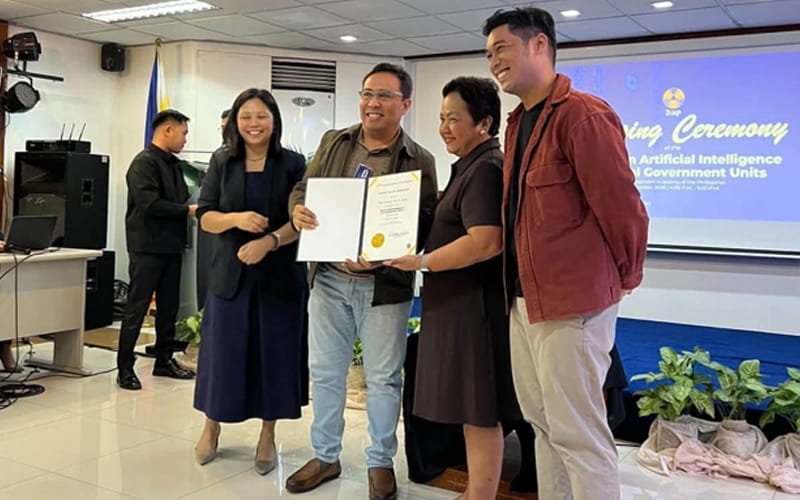
Balite received a Certificate of Completion from DAP, signed by Leocadio S. Sebastian, PhD, CESO I, Acting President and Chief Executive Officer, recognizing his successful completion of the 32-hour course conducted by the Academy’s Center for Governance.
His participation as the lone mayor across the first three batches of the DAP AI course underscores the importance of local chief executives taking an active role in understanding emerging technologies and exploring their practical applications in governance.
For Valencia, the training represents more than another professional achievement for its local chief executive. It signals an opportunity to bring the benefits of artificial intelligence closer to the grassroots, where improved government responsiveness can make a meaningful difference in people’s everyday lives.
As Balite returns to Valencia armed with new knowledge and renewed determination, his challenge is clear: to transform artificial intelligence from a promising technology into a practical instrument of inclusive, accountable, and compassionate public service true to the spirit of BARUG Valencia.