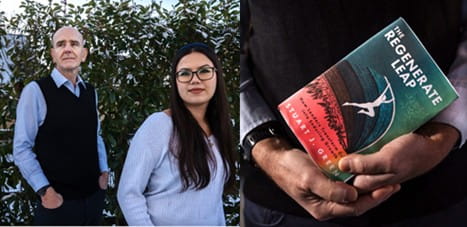
THE husband of the slain mother-lawyer-environmentalist Mia Mascarinas, who was murdered on February 15, 2017, penned a book he called The Regenerate Leap, in an attempt to upset his traumatic experience, “not only to survive but thrive,” The Guardian, a prominent online news outfit in England, reported.
Stuart Green, a marine biologist is said to be from Hertfordshire, England, British Broadcasting Corp., said.
The book was expected to have been published in January this year.
Mia Mascariñas-Green, was killed when two gunmen unloaded over 20 bullets into her with her three kids and a nanny at the back of the family car. According to BBC, nine bullets pumped by the gunmen hit her for her immediate death.
Mascarinas-Green was forced to stop the vehicle she was driving with her children when a motorbike reportedly blocked her way. After pumping bullets to her, the gunmen proceeded to the back of the car. It was just a miracle that when the gunmen point their weapons to the back the weapons jammed.
Mascarinas-Green’s twins, who were less than two at the time, their older sister, who was 10, and the nanny were unharmed and safe.
Lloyd Lancer Gonzaga, 34, a resident of Panglao town in Bohol, believed to be the mastermind of Mascarinas killing was arrested after four months in hiding by the Criminal Investigation and Detection Group (CIDG). Some of the gunmen were also reportedly nabbed.
The motive for his wife’s death is believed to be a land ownership disputed of a holiday hotel between the alleged mastermind and his kin. But justice for the murder of Mascarinas, a prominent lawyer officer of Environmental Law Assistance Center (ELAC), is still elusive.
The following is how Green described and why he put in words the experience. “I’m not saying the devastation is good,” he writes. The philosophy is to honestly acknowledge the loss, then to use the crisis as a catalyst to grow into something that could never have existed without the “fire”.
“In all the literature, it’s about being strong and resilient, and seeing your way through,” he says. That, he concluded, was not possible for his family – they had lost a wife, a mother, a home, their dogs, a whole life in a beloved country. “It was a wipeout,” he says. “So there is no resilience.”
Still, Green did find one thing in those books, which scared rather than consoled him. It was the concept of intergenerational trauma, passed down from parents to children. “I realized that the children would be carrying on the narrative,” he says.
The core idea of the book is the concept of “regeneration”, which he writes, is “not the absence of pain” but “transforming your pain into your purpose.”
The book’s central metaphor is the pine cone that releases its seeds only under the intense heat of a forest fire. Green argues that crises can “crack us open” to release dormant strengths. (Ric Obedencio)