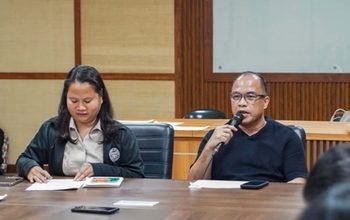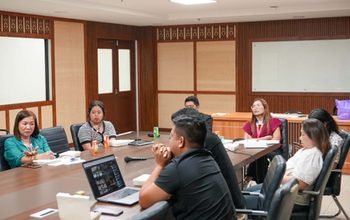
BOHOL positions local development priorities alongside the region’s long-term growth agenda as provincial and regional officials convene for the Regional Development Plan (RDP) 2023–2028 Midterm Update and Regional Physical Framework Plan (RPFP) 2026–2050 Roadshow.
Held on November 18, 2026, at the Ceremonial Hall of the Provincial Capitol, the activity focused on aligning local development directions with regional priorities through coordinated planning, sustainable land use, and strategic investments.
Governor Aris Aumentado, represented by Executive Assistant Oscar Valles, emphasized that regional development must go beyond economic growth and infrastructure investments, stressing the need for sound planning, sustainable resource management, and a shared vision.
Valles said the RDP sets regional development priorities and strategies, while the RPFP provides spatial direction for the coordinated and sustainable use of land and resources.
He called on LGUs, national government agencies, the private sector, civil society organizations, and development partners to translate the plans into concrete programs, projects, and interventions.
Department of Economy, Planning, and Development (DEPDev) 7 Regional Director Jennifer Bretaña, CESO III, discussed the RPFP’s rationale, highlighting spatial planning as the management of space and development to create better places that respond to society, the economy, and the environment.
She presented four land use policy areas: spaces for living through settlement development; spaces for making a living through production land use; spaces connecting communities and economic activities through infrastructure; and spaces sustaining life through the protection of natural resources and life-support systems.
Bretaña explained that the RPFP provides LGUs, national agencies, and development partners a common reference for determining where and how the region should grow.
It guides public and private investments, promotes efficient use of land and physical resources, and informs local development and land use plans.
Meanwhile, DEPDev 7 Chief Economic Development Specialist Architect Neil Andrew Menjares presented the Central Visayas RDP Midterm Update and RPFP 2026–2050, and discussed its alignment with AmBisyon Natin 2040: a matatag, maginhawa, at panatag na buhay for all Filipinos.
By 2050, the framework envisions Central Visayas as a resilient region leading globally in heritage, tourism, education, and trade, and serving as the country’s logistics, innovation, and technology hub.
This vision is anchored on an inclusive economy, climate-resilient ecosystems, proactive and corruption-free governance, and empowered communities.
By 2028, the region targets a gross regional domestic product growth rate of 6.3% to 7.5%.
Menjares explained the Regional Spatial Development Framework (RSDF), which identifies LGU clusters’ functional roles based on their geographical characteristics, economic strengths, and regional importance.
Its primary strategy, decentralized concentration, addresses overconcentration in major urban centers by directing growth toward secondary and tertiary centers.
Central to this strategy is the Pusô Network, inspired by Bohol and Central Visayas’ traditional hanging rice and symbolizing the interconnectedness of communities.
It promotes a polycentric structure where growth centers complement one another.
The presentation outlined stakeholder roles in carrying out the RPFP.
LGUs are encouraged to use it in preparing their Comprehensive Land Use Plans, Comprehensive Development Plans, and Local Development Investment Programs.
National agencies are expected to align their plans and investments with its directions, while civil society organizations, the academe, and the business sector can align their programs and initiatives with regional priorities.
The framework is indicative, with LGUs responsible for translating its directions into local policies and implementation measures through zoning ordinances.
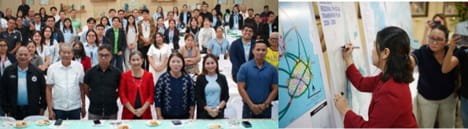
The roadshow featured the ceremonial ribbon-cutting of the RPFP maps and signing of a Pledge of Support.
BIUGGp Development Communications Strategist Queenie Maria Guibao shared Bohol’s “From the Ground Up” journey toward UNESCO Global Geopark designation, highlighting community participation in protecting and promoting the island’s geological, cultural, and natural heritage.
Among those present were Congresswoman Alexie Besas-Tutor, Vice Governor Nick Besas, Board Members Dionisio Joseph Balite, Romulo Cepedoza, Nathaniel Binlod, Lucille Lagunay, Jamie Aumentado-Villamor, Venzencio Arcamo, and Joahna Cabalit-Initay.
PPDO Head Atty. John Titus Vistal, PDRRMC Head Dr. Anthony Damalerio, Provincial Legal Officer Atty. Handel Lagunay, BCCAD Head Emerson Pinos, PIMO Administrative Officer V Marc Anthony Pernia, local government unit officials, civil society organizations, and academe were also present.
The initiative reinforces the PGBh’s commitment to coordinated, sustainable development and supports the Capitol’s Strategic Governance Roadmap and ongoing efforts of Bohol to preserve its status as the Philippines’ first and only UNESCO Global Geopark. (PIMO/MFM)