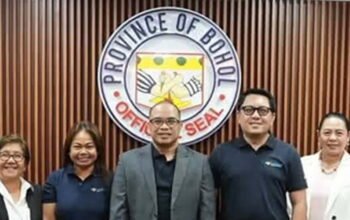
BOHOL continues to champion environmental conservation through strengthened bamboo nursery training and sustainable seedling production.
The Provincial Government of Bohol (PGBh), under the leadership of Gov. Aris Aumentado, through the Bohol Provincial Environment and Management Office (BPEMO), conducted a two-day training on Bamboo Nursery Establishment, Management, and Seedling Production on September 24–25, 2026, at the Bohol Biodiversity Complex in Bilar, Bohol.
The training aimed to build the capacities of local stakeholders in establishing and managing bamboo nurseries and producing quality planting materials, while supporting efforts to address environmental concerns through sustainable bamboo development.
Forester Jomar Cuerbo discussed the rationale of the activity, emphasizing the need to strengthen local technical capacities and promote sustainable approaches to bamboo propagation and nursery management.
On the first day, Adelo Caberte, Auditor of the Bohol Bamboo Industry Development Council (BBIDC), facilitated lectures covering nursery establishment, site selection, design and layout, and the tools and materials required for nursery operations.
Participants also learned about the selection, collection, handling, and storage of seeds and propagation materials, as well as various bamboo propagation methods.
Discussions further covered nursery management practices, including watering and fertilization, pest and disease management, shading, and hardening-off techniques.
The second day focused on hands-on activities led by Caberte, allowing participants to apply the concepts discussed during the lectures.
Activities included nursery layout demonstration, preparation of potting media and seedbeds, seed sowing, preparation of bamboo cuttings and propagules, proper labeling and record-keeping, and transplanting seedlings into polybags.
Participants also practiced organic fertilizer application and learned monitoring and maintenance techniques to support healthy and sustainable seedling production.
The training also included a workshop on municipal action planning and target-setting for bamboo production, enabling participants to identify practical steps and production targets that can be implemented at the local level.
Carlo Roaldo Escobilla of the Department of Trade and Industry-Bohol also delivered a lecture on the bamboo value chain, providing participants with an overview of opportunities for developing bamboo beyond nursery production and linking it to livelihood and local economic activities.
Aligned with the PGBh’s Strategic Governance Roadmap, the activity forms part of continuing efforts to strengthen community-based environmental management.
This also promotes bamboo as a sustainable resource for ecological protection, livelihood development, and climate resilience in Bohol, the country’s first and only UNESCO Global Geopark. (PIMO/JFP)